Routing Entanglement in the Quantum Internet
Assumptions
- Each network repeater node equipped with:
- Quantum memories that can hold a qubit perfectly for some predefined time.
- Entanglement sources.
- Ability to perform Bell state measurements between any pair of locally-held qubits.
- Classical computing resources and communication interface.
- Each network repeater node is aware of the overall network topology, as well as the locations of the Source-Destination pairs.

Outline
In 1 they develop and analyze routing protocols for generating maximally entangled qubits (ebits) simultaneously between single or multiple pairs of senders and receivers in a quantum network by exploiting multiple paths in the network. They introduce protocols for quantum repeater nodes in the following scenarios:
- Multipath routing of a single entanglement flow:
- Considering nodes with global link-state information (the state of every link is known to every repeater in the network and can be used).
- Considering nodes with local link-state information (a link knows the states of it neighbors).
- Multipath routing of simultaneous entanglement flows:
- Considering nodes with local link-state information.
All of the protocols above considering their characteristics are divided in two phases with the objective of creating an unbroken end-to-end connection between the source and destination nodes. The external and the internal phase which occur in this order.
- External phase: each pair of memories (neighboring repeaters) across an edge attempts to establish a shared entangled (EPR) pair.
- Internal phase: BSMs are attempted within each memory (repeater node) based on the successes and failures of the neighboring links in the external phase.
The high-level objective is: Considering the assumptions of quantum and classical operations at each of the repeater nodes of the underlying network, what operations should be performed at the repeater to achieve maximum entanglement-generation rate for one sender and receiver or achieve maximum rate region for multiple flows of entanglement.
Notation
Quantum network with topology described by a graph :

- Each of the nodes is equipped with a quantum repeater.
- Each of the edges is a lossy optical channel of range (km) and power transmissivity , and depends on the material of the channel.
- Source-Destination pairs , situated at (not necessarily distinct) nodes in .


Considering this graph we adopt the following notation for the repeater network.

- Each node is a repeater.
- Each edge is a physical link connecting two repeater nodes.
- is an integer edge weight corresponding to the number of parallel channel across edge .
- is the set of neighbor edges of
- is the degree of node .
- is the number of memories at node .
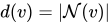
- distance of a node to the node A, using the norm.
- An ebit represents a maximally entangled qubit.




Properties
Protocol Description
- All of the three protocols below assume that time is slotted and each memory can hold a qubit perfectly for time slot. After this time the stored qubit completely decoheres.
- Each time slot , is divided into 2 phases:
- External Phase:
- Each of the pairs of memories across and edge attempts to establish an EPR pair.
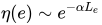
- - An entanglement attempt across any one of the parallel links across edge succeeds with probability , where is the transmissivity of a lossy optical channel of length .
- Using two-way classical communication over edge , neighboring repeater nodes learn which of the S(e) parallel links (if any) succeeded in the external phase, in a given time slot.




- Internal Phase:
- BSMs are attempted locally at each repeater node between pairs of qubit memories based on the success and failure of the neighboring links in the external phase.
- - These BSM attempts are called internal links, i.e., links between memories internal to a repeater node.
- - Each of these internal-link attempts succeed with probability .

At the end of one time-slot a along a path comprising of edges (and thus repeater nodes) one ebit is successfully shared between the end points of the path with probability .


The maximum number of ebits that can be shared between node and node after one time-slot is , assuming is the same over all edges.




The protocols described below focus on finding the optimal strategy for each repeater node in order to decide which locally held qubits to attempt BSMs during the internal phase of a time slot. Based on the outcomes of the external phase and considering global or local link-state knowledge and .
Multipath Routing of a Single Entanglement Flow
Input: , Source-Destination pair .


Output: Quantum network with ebits shared between the end points of .
Protocol for Entanglement Routing with Global Link-state Information
After the External Phase
- = Subgraph induced by the successful external links and the repeater nodes after the external phase.
- While (True):
- = shortest path in connecting with .
- If is empty: Break While Loop.
- Else:
- Set as the length of .
- Try connecting all internal links along the nodes of
//successfully generating an ebit between and with probability
- = all external and internal links of .


Protocol for Entanglement Routing with Local Link-state Information
Knowledge of success and failure of the External Phase is communicated only to the two repeater nodes connected by the link. Repeater nodes need to decide on which pair(s) of memories BSMs should be attempted (which internal links to attempt), based only on information about the states of external links adjacent to them.
After the External Phase
- For every repeater except and :
Let be the node of this iteration.- If less than one of the neighboring external links is successful:
no internal links are attempted since this repeater node can not be part of a path from to . - If two or more neighboring external links are successful:
Let be the node linked to with the smallest Failed to parse (Conversion error. Server ("https://wikimedia.org/api/rest_") reported: "Cannot get mml. Server problem."): {\displaystyle d_{A_{1}}} and be the node linked to with the smallest .
Attempt a BSM on node on the memories connected to and .- If four neighboring external links are successful:
Attempt a BSM on node on the remaining memories disconsidering the two memories from the previous step.
- If four neighboring external links are successful:
- If less than one of the neighboring external links is successful:


Protocol for Simultaneous Entanglement Flows with Link-state Information
Input: , Source-Destination pairs and .


Output: Quantum network with ebits shared between the end points of and .
This situation motivates the Multi-flow Spatial-division rule which divides the the network between two spatial regions corresponding to the two flows.
- When the shortest path connecting the two source-destination pairs do not cross the network is divided between two spatial regions corresponding to the two flows.
- For each one of this regions we apply the Protocol for Entanglement Routing with Local Link-state Information.
- When the shortest path connecting the two source-destination pairs do cross the network is divided between two spatial regions corresponding to the two flows.
- Considering the square-grid topology the two spatial regions are divided by two crossing lines with an angle between them (forming a hourglass shape).
- For each one of this regions we apply the Protocol for Entanglement Routing with Local Link-state Information.
