Anonymous Conference Key Agreement using GHZ states
This example protocol achieves the functionality of quantum conference key agreement. This protocol allows multiple parties in a quantum network to establish a shared secret key anonymously.
Assumptions
We require the following for this protocol:
- A source of n-party GHZ states
- Private randomness sources
- A randomness source that is not associated with any party
- A classical broadcasting channel
- Pairwise private communication channels
Outline
- First, the sender notifies each receiver in the network anonymously
- The entanglement source generates and distributes sufficient GHZ states to all nodes in the network
- The GHZ states are distilled to establish multipartite entanglement shared only by the participating parties (the sender and receivers)
- Each GHZ state is randomly chosen to be used for either Verification or Key Generation. For Key Generation rounds, a single bit of the key is established using one GHZ state by measuring in the Z-basis
- If the sender is content with the Verification results, they can anonymously validate the protocol and conclude that the key has been established successfully.
Notation
Protocol Description
Protocol 1: Anonymous Verifiable Conference Key Agreement
Input: Parameters and


Requirements: A source of n-party GHZ states; private randomness sources; a randomness source that is not associated with any party; a classical broadcasting channel; pairwise private communication channels
Goal: Anonymoous generation of key between sender and Failed to parse (SVG (MathML can be enabled via browser plugin): Invalid response ("Math extension cannot connect to Restbase.") from server "https://wikimedia.org/api/rest_v1/":): {\displaystyle m} receivers
- The sender notifies the receivers by running the Notification protocol
- The source generates and shares Failed to parse (SVG (MathML can be enabled via browser plugin): Invalid response ("Math extension cannot connect to Restbase.") from server "https://wikimedia.org/api/rest_v1/":): {\displaystyle L} GHZ states
- The parties run the Anonymous Multipartite Entanglement protocol on the GHZ states
- For each Failed to parse (SVG (MathML can be enabled via browser plugin): Invalid response ("Math extension cannot connect to Restbase.") from server "https://wikimedia.org/api/rest_v1/":): {\displaystyle (m+1)}
-partite GHZ state, the parties do the following:
- They ask a source of randomness to broadcast a bit Failed to parse (SVG (MathML can be enabled via browser plugin): Invalid response ("Math extension cannot connect to Restbase.") from server "https://wikimedia.org/api/rest_v1/":): {\displaystyle b} such that Pr
- Verification round: If b = 0, the sender runs Verification as verifier on the state corresponding to that round, while only considering the announcements of the receivers. The remaining parties announce random values.
- KeyGen round: If b = 1, the sender and receivers measure in the Z-basis.
- If the sender is content with the checks of the Verification protocol, they can anonymously validate the protocol

![{\displaystyle [b=1]={\frac {1}{D}}}](https://wikimedia.org/api/rest_v1/media/math/render/svg/822432f80b194cbf37ecdd148ab3f484e57ba705)
Protocol 2: Notification
Input: Sender's choice of receivers
Goal: The receivers get notified
Requirements: Private pairwise classical communication channels and randomness sources
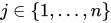
For agent Failed to parse (Conversion error. Server ("https://wikimedia.org/api/rest_") reported: "Cannot get mml. Server problem."): {\displaystyle i=1,...,n} :
- All agents do the following:
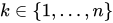
- When agent Failed to parse (Conversion error. Server ("https://wikimedia.org/api/rest_") reported: "Cannot get mml. Server problem."): {\displaystyle j} is the sender: If is not a receiver, the sender chooses random bits such that . Otherwise, if is a receiver, the sender chooses random bits such that . The sender sends bit to agent Failed to parse (Conversion error. Server ("https://wikimedia.org/api/rest_") reported: "Cannot get mml. Server problem."): {\displaystyle k}
- When agent Failed to parse (Conversion error. Server ("https://wikimedia.org/api/rest_") reported: "Cannot get mml. Server problem."): {\displaystyle j} is not the sender: The agent chooses random bits such that and sends bit to agent Failed to parse (Conversion error. Server ("https://wikimedia.org/api/rest_") reported: "Cannot get mml. Server problem."): {\displaystyle k}
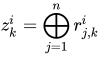
- All agents receive , and compute and send it to agent
- Agent takes the received to compute . If , they are thereby notified to be a designated receiver.





Protocol 3: Anonymous Multiparty Entanglement
Input: -partite GHZ state
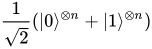
Output: -partite GHZ state shared between the sender and receivers

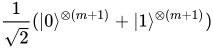
Requirements: A broadcast channel; private randomness sources
- Sender and receivers draw a random bit each. Everyone else measures their qubits in the X-basis, yielding a measurement outcome bit
- All parties broadcast their bits in a random order, or if possible, simultaneously.
- The sender applies a Z gate to their qubit if the parity of the non-participating parties' bits is odd.

Protocol 4: Verification
Input: A verifier V; a shared state between Failed to parse (Conversion error. Server ("https://wikimedia.org/api/rest_") reported: "Cannot get mml. Server problem."): {\displaystyle k} parties
Goal: Verification or rejection of the shared state as the GHZ state by V

Requirements: Private randomness sources; a classical broadcasting channel
- Everyone but V draws a random bit and measures in the X or Y basis if their bit equals 0 or 1 respectively, obtaining a measurement outcome Failed to parse (SVG (MathML can be enabled via browser plugin): Invalid response ("Math extension cannot connect to Restbase.") from server "https://wikimedia.org/api/rest_v1/":): {\displaystyle m_i} . V chooses both bits at random
- Everyone (including V) broadcasts Failed to parse (SVG (MathML can be enabled via browser plugin): Invalid response ("Math extension cannot connect to Restbase.") from server "https://wikimedia.org/api/rest_v1/":): {\displaystyle (b_i,m_i)}
- V resets her bit such that Failed to parse (SVG (MathML can be enabled via browser plugin): Invalid response ("Math extension cannot connect to Restbase.") from server "https://wikimedia.org/api/rest_v1/":): {\displaystyle \sum_ib_i = 0 (} mod Failed to parse (SVG (MathML can be enabled via browser plugin): Invalid response ("Math extension cannot connect to Restbase.") from server "https://wikimedia.org/api/rest_v1/":): {\displaystyle 2)} . She measures in the X or Y basis if her bit equals 0 or 1 respectively, thereby also resetting her Failed to parse (SVG (MathML can be enabled via browser plugin): Invalid response ("Math extension cannot connect to Restbase.") from server "https://wikimedia.org/api/rest_v1/":): {\displaystyle m_i = m_v}
- V accepts the state if and only if Failed to parse (SVG (MathML can be enabled via browser plugin): Invalid response ("Math extension cannot connect to Restbase.") from server "https://wikimedia.org/api/rest_v1/":): {\displaystyle \sum_im_i = \frac{1}{2}\sum_ib_i (} mod Failed to parse (SVG (MathML can be enabled via browser plugin): Invalid response ("Math extension cannot connect to Restbase.") from server "https://wikimedia.org/api/rest_v1/":): {\displaystyle 2)}
